

 ChatGPT
 Perplexity
 Claude
 Gemini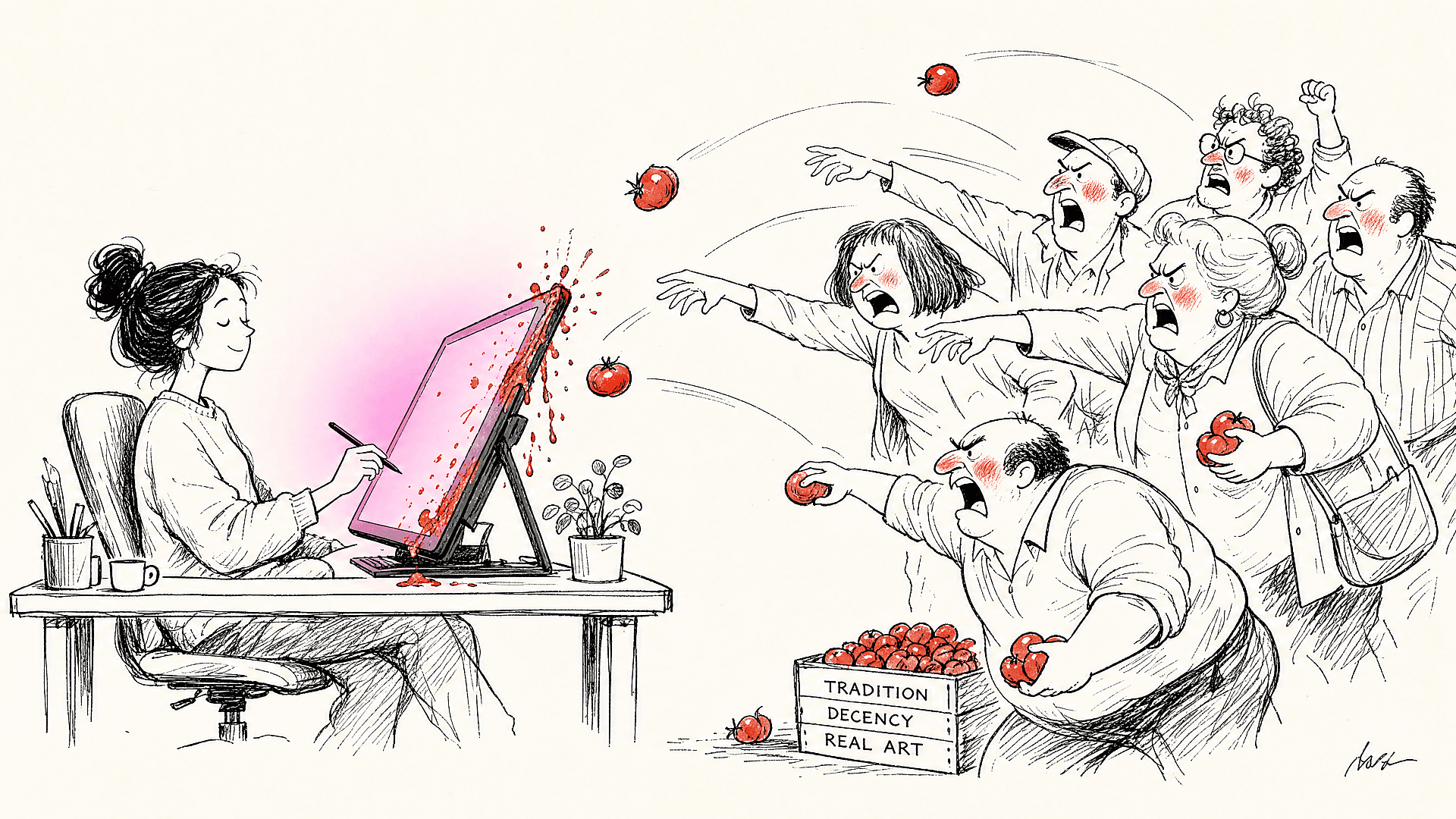
If you're even remotely online right now, you've seen the comments. They show up under any post that looks slightly AI-adjacent, in the quote-tweets, in the half-second verdict someone delivers out loud in their own video while reacting to someone else's: "ugh, this is AI." Sometimes it's "ew, AI, unfollowing," sometimes it's a single disgusted word, sometimes it's a long paragraph about everything wrong with the world. The wording barely matters because the sentiment is always the same, a mix of disgust and finality, the sound of a door closing. And it's become common enough that creators are now quietly engineering their work to avoid setting it off, adding disclaimers, obfuscating their process, over-explaining how much human effort went in, or backing away from the tools altogether.
It's worth slowing down to look at what's actually inside that reaction, because what reads as a single wall of rejection is usually four separate objections compressed into one reflex, and they aren't equally fair, not equally aimed at you, and not answerable in the same way. Pulling them apart turns out to be the most useful thing a creator can do, both for their own peace of mind and for the quality of the conversation everyone keeps failing to have.
First, the slop
The first objection buried in the reaction is about slop, because somewhere in the person's recent memory is an endless scroll of low-effort, mass-generated content: the same five faces, the same plastic lighting, the same engagement-bait carousels churned out by the thousand. That reaction is completely reasonable, since slop is real and everywhere and genuinely degrades the experience of being online for everyone. But the objection's really about effort and intention rather than about the tool itself, and carelessness predates AI by a few thousand years. Thoughtful work made with these tools shares nothing with slop except the underlying technology, which makes "ew, AI" land a little like refusing to read at all because some books are poorly written.
Then, the theft
The second objection has real teeth, and it's about theft. Many image models were trained on the work of living artists who never consented and were never paid, and a great deal of the legitimate anger about AI traces directly back to that fact, which deserves to be taken seriously rather than waved off. What's worth noticing is that this is a specific grievance about how certain models were built and how the industry has handled consent, not a blanket indictment of everyone who's ever opened one of the tools. It points toward genuine questions about training data, licensing, and which platforms a creator chooses to work with, but it doesn't actually resolve into the conclusion that you, personally, are contemptible for having made something.
There's also the cost
The third objection is about cost in the most literal sense, since the energy and water required to train and run large models at scale is a real environmental concern that's entirely fair to raise. Like the others, though, it operates at the level of infrastructure rather than the level of the individual, a question about how these systems are built and powered and at what scale, which sits with companies, energy grids, and the regulatory bodies meant to hold them accountable rather than with one person making one image on a random Tuesday.
We've been here before with other environmental anxieties, where the burden gets quietly transferred from the institutions that could actually move the needle onto ordinary people going about their lives. The very idea of a personal "carbon footprint" was popularized in the early 2000s by an ad campaign for the oil giant BP, explicitly to shift responsibility for climate change away from fossil fuel companies and onto individual consumers, and the same move has been run on recycling and a dozen other problems. It works because guilt is easier to manufacture than systemic change. Pointing disgust at a single creator follows the same logic, and it belongs in the conversation about AI's real costs the same way your recycling bin belongs in the conversation about climate: it's not nothing, but it's not where the actual leverage is.
And underneath it all, the fear
The fourth objection is the quiet one underneath all the others, and it's the one actually generating the disgust: the sense that AI creativity threatens something essential about being human. The research on this is surprisingly direct. One study spanning six experiments found that people devalue art the moment it's labeled AI-made, even when they admit they can't distinguish it from human work, and even when they're told a human collaborated on it. A separate study out of UBC found the bias runs strongest in people who believe creativity is a uniquely human trait, and that they'll pay more for work they think a person made. What that points to isn't an argument so much as an identity reflex. It comes from an understandable place, the fear that if a machine can make something beautiful then our specialness is suddenly in question, but it's a feeling about the human condition that's been projected onto your creations.
If that sounds bleak, it shouldn't, because we have watched this exact fear play out before and we know how the story ends. In the 1800s, photography was dismissed as soulless and mechanical, an insult to real painting, before it became one of the most expressive forms we have. A century later, synthesizers were going to make musicians obsolete, right up until they became the backbone of nearly every song you love. The panic that something stops being human the moment a machine is involved is not new, and it has lost every single time. There is no reason to believe this round ends any differently.
The sleight of hand, and why it feels impossible to argue with
Something clarifying happens when you set these four objections side by side. Slop is a problem of effort, theft is a problem of consent and law, environmental cost is a problem of infrastructure, and the "it's not real" reaction is a problem of philosophy and identity, which means they have different causes, different solutions, and different people responsible for addressing them. Almost none of those people is the individual creator who made something with care and caught a stray "boooo AI 🍅" for the trouble.
This is also why arguing with comments like these never quite gets you anywhere. Respond to the slop point and the person slides to theft; address theft and they pivot to "it's just soulless"; answer that and you're suddenly talking about data centers. The objection keeps relocating because it was never one coherent argument to begin with, just several half-sorted feelings bundled together, and every time you address one, the others are still standing there waiting to be picked up.
What this means for creators
The goal, then, isn't to win the argument but to unravel it, because once the four objections come apart two things become clear at the same time. The legitimate concerns, theft and labor and environmental cost, genuinely deserve to be taken seriously, and the right response to them is engagement, not denial: choosing tools built responsibly, being honest about your process, pushing for better practices across the industry. The identity panic, meanwhile, the part doing most of the emotional work behind AI shaming, was never really about your work at all. It was about someone else's relationship to a changing world, and it's not a verdict you're obligated to accept on their behalf.
None of this makes the shaming stop, and it'll probably get louder before it settles, because we're living through the noisy early stretch of a real cultural adjustment and those stretches always sound like this. But the disgust, loud as it is, was mostly aimed at slop, at extractive companies, at energy infrastructure, and at a philosophical anxiety as old as every previous technology that ever made people wonder what would be left for humans to do. Very little of it was ever aimed at you. So make your work, use new tools to make it, and take the real questions seriously enough to have actual answers when they come up. The creators who come through this era well won't be the ones who hide their process or the ones who pretend the concerns are fake, but the ones who can hold the whole picture at once, and that kind of clarity will always be worth more than a disclaimer.